×
App Icon
The Standard e-Paper
Informed Minds Prefer The Standard
★★★★ - on Play Store
Download Now

Ethiopia announces elections for June next year

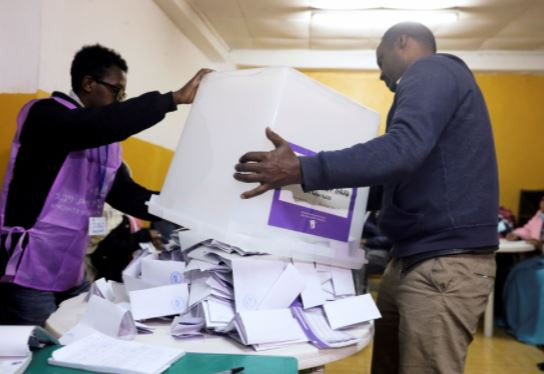
Election officials empty a ballot box during the 2021 Ethiopian parliamentary and regional elections, in Addis Ababa, Ethiopia.[Reuters]

Parliamentary elections in Ethiopia will be held on June 1 next year, the electoral commission said, despite the country still enduring armed conflict.

Ethiopia is the second most populous country in Africa, with some 130 million inhabitants, but ongoing fighting in its two most populated regions has displaced millions.

In a statement before Parliament on October 28, Prime Minister Abiy Ahmed said "the government has the capacity and the will necessary to conduct these elections", adding they will be the "best organised" in Ethiopia's history.

On Tuesday, the country's electoral commission told local media that polls would be held on June 1.


But organising the vote in the sprawling nation presents numerous challenges.

Ethiopia is still emerging from a civil war that ravaged northern Tigray from November 2020 to November 2022, pitting rebels from the Tigray People's Liberation Front (TPLF) against federal forces, supported by local militias and the Eritrean army.

The African Union says the conflict resulted in 600,000 deaths, although some analysts believe this is an underestimate. The United Nations says roughly one million people remain displaced.

Ethiopia is also facing armed conflicts in Oromia, which stretches across roughly a third of the country and has a population of over 40 million, where federal forces are facing the Oromo Liberation Army, designated a "terrorist organisation" by Addis Ababa.

In Amhara, "self-defence" militia Fano took up arms against the government in April 2023 over federal authorities' attempts to disarm them.

A state of emergency was declared for nearly a year but failed to end the fighting, and parts of Amhara remain outside the control of federal authorities.

Jonah Wedekind, of the German Arnold Bergstraesser Institute, told AFP it was vital for Abiy to hold elections, "both from a domestic political perspective and for the international community".

Financing is also a challenge in a country still emerging from the Tigray war, and dependent on aid from the International Monetary Fund and the World Bank.

A diplomat in Addis Ababa, who requested anonymity, said the electoral commission had "scaled back its financial ambitions".

It had initially planned a budget of $150 million, with 50 percent coming from the federal government and 50 percent from international donors.

"But very few partners are willing to commit," the diplomat said, with the budget reduced to $100 million.