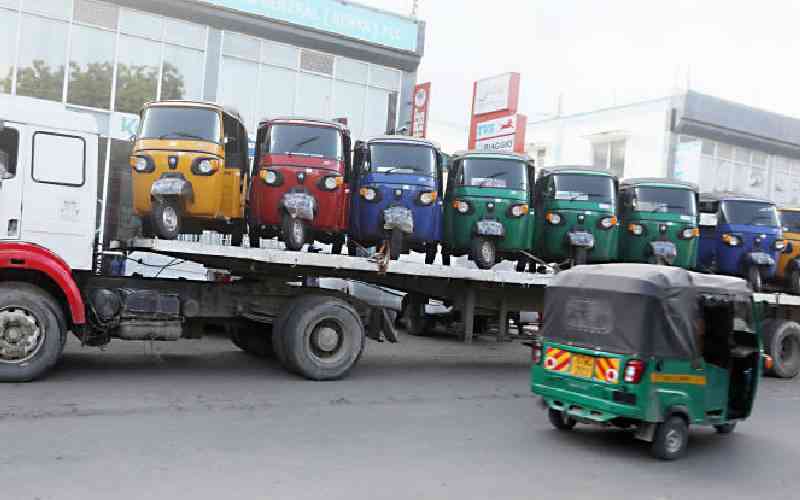
Imported tuk tuks being transported from Mombasa to upcountry, on March 21, 2024. [File, Standard]
Each night, wind turbines spin across the Rift Valley, geothermal wells bubble beneath Naivasha, and hydro stations hum—producing about 3,000 megawatts of electricity. But, with most of the country asleep, that energy goes unused. Under long-term take-or-pay contracts, we still pay for it.
That idle power tells a bigger story. It is not just about electricity; it is about missed opportunities. One of the most innovative ways to seize this opportunity is by rethinking the future of mobility. Across Kenya, boda boda and tuk tuks form the backbone of everyday mobility. They move people and parcels, connect homes to markets, and keep informal businesses alive.
However, most of them run on petrol and diesel, which is expensive. Every litre paid in foreign currency deepens our trade deficit and exposes us to oil price shocks. Moreover, they contribute significantly to air pollution, making transport a major source of Kenya’s emissions.
Now, imagine if those same boda bodas and tuk tuks were electric. Picture them quietly charging at night, utilising the surplus power that currently goes unused. Every electric kilometre would replace imported fuel with clean, domestic energy. This shift would not only be an environmental win but also a smart economic strategy.
Kenya imports nearly all of its transport fuel and two-and three-wheelers consume nearly half of it. They are the fastest-growing segment on our roads, accounting for more than 70 per cent of all new vehicle imports, although that share dipped to 56 per cent in 2024. Electrifying them would deliver immediate and massive impact: Reduced pollution, lower fuel costs and keeping resources in the country.
We are not there yet—not because the idea lacks merit, but because the system is not ready. Electric two-and three-wheelers still cost 20–60 per cent more than petrol models. Most riders earn daily cash incomes, lack credit histories, and cannot access formal loans—leaving them exposed to informal lenders charging up to 50 per cent interest. Charging stations are scarce, and few mechanics know how to fix electric bikes.
This is a system problem, not a technology problem —and it can be solved by focusing on three critical areas: Bankability, reliability and scale. Riders need affordable loans, structured around their daily earnings, with local banks offering fair rates, supported by guarantees and concessional funds. Charging should be cheapest at night, when the grid has surplus power.
Reliability means trust. Riders are unlikely to make the switch if they fear breakdowns or short battery life. Regulators must establish and enforce clear standards for vehicles and batteries, require warranties, and train mechanics in electric vehicle maintenance and safe battery handling.
After ensuring reliability, we must focus on scale. It starts with predictable users—county fleets, deliveries and health services. Government can lead by aggregating demand and setting targets. Once anchor customers are in place, private investment will build out charging, swapping, and local jobs.
That’s the vision behind ‘Safiri Electric’—a new initiative backed by the Kenyan government, World Resources Institute (WRI), the Mitigation Action Facility and partners. It is designed to unlock affordable financing for riders, attract infrastructure investment and professionalise the entire e-mobility ecosystem. The timing couldn’t be better. We have the clean power, strong demand and the burden of costly fuel imports.
Dr Mwaniki is Head of Air Quality, WRI Africa and Country Representative, Kenya