×
App Icon
The Standard e-Paper
Read Offline Anywhere
★★★★ - on Play Store
Download Now

Kenya's great socio-economic divide laid bare by Oxfam report

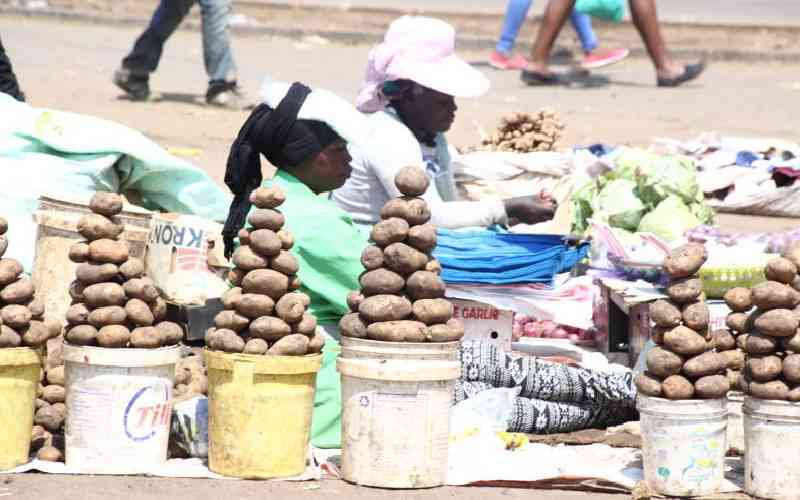
Traders at Wakulima market in Nairobi. [File, Standard]

Oxfam Kenya recently released a report titled Kenya’s Inequality Crisis: The Great Economic Divide to the masses through its website, and this report has gained the necessary traction needed to set the conversation rolling.

The report is in fact less an academic exercise than a political provocation, calling on Kenyans to face the realities of what our current situation is as a country.

The report stitches together household surveys, wealth estimates and public finance analysis to show that growth figures mask a country becoming more unequal, with a tiny elite that is accumulating vast financial wealth while tens of millions are sliding into poverty.


The most damning revelation in the report, and the one easiest to visualise in order to understand our inequalities, is the finding that the richest 125 Kenyans now hold more wealth than roughly 42–43 million Kenyans combined.

The number 125 is most shocking, considering that this is a sum of people that could comfortably fit in a small room, and to imagine that they more wealth than over 42 million fellow Kenyans is to imagine that nearly the entire country is struggling to survive. This would explain the sufuria protests of 2013 that were so denigrated, as well as subsequent protests that the IMF predicted were bound to occur due to severe taxation of a people already barely making it.

If the inequalities are then found to be this wide, there is no expecting protests to stop any time soon, unless drastic solutions are found.

The inequalities also explain why money lending has become a primary form of business in this country, supplemented by betting. With the report finding that most Kenyans live on less than 2 dollars a day, and nearly half live in extreme poverty (less than a dollar a day), most people are forced to supplement meager incomes through cash lending apps that work with exorbitant interest rates. Betting also offers an opportunity to supplement finances by presenting a low entry point that could result in big wins. The reality is however different, with very few winning, most people losing more than they can afford to, and a smaller number ending up with a gambling addiction.

When analyzing the financial State of the nation, it is important to remember that these outcomes are not coincidental, but rather are systemic in nature. A number of insitutionalised factors and policies are behind this great divide that we see today, and the government is in cahoots as the implementer of these systems.

Oxfam identifies several interlinked drivers. First is the extreme concentration of financial assets and corporate ownership in the hands of a small elite, reinforced by soaring executive pay (the report cites examples such as CEOs in Kenya’s largest firms earning in the order of hundreds of times a teacher’s salary).

Second is the erosion of public provisioning, as debt servicing and opaque tax exemptions are crowding out spending on health, education and social protection.

Third is our tax policy itself, which is a combination of narrow tax bases, over-generous incentives and weak enforcement, a condition that allows wealth to be accumulated and shielded from redistribution. Fourth, the report points to gendered and geographic dimensions, noting that women, informal workers and residents of arid and marginalised regions are hit hardest.

Of all these factors, the one that bears needing primary attention is that of debt servicing. Whilst funding for education is at an all-time low, and medical services continue to become inaccessible due to doctor strikes, lack of social health insurance and overall poor facilities, Kenya’s budget allocates a 68% share to debt repayment.

This is a ridiculous figure by any accounts, as it clearly shows that more than half the money that belongs to Kenyans is not used on Kenyans. If we consider further that a lot of the money loaned to Kenya is lost to corruption, the pain is only worsened as we realise that we are paying for loans we never got to benefit from.

The consequences of these choices are clear: not too long ago, hundreds of babies died in Kiambu County due to the doctor’s strike. Malnutrition, hunger and disease continue to cause death in the rural areas. For most youth today, mental illness caused by financial precarity continue to be on the rise, and many lives are lost to suicide as a consequence every year.

For those brave enough to stand up and protest these inhuman living conditions, the State resorts to violence, ensuring that those who survive these economic conditions will die through police brutality. The State has become a harbinger of death, and we must begin to count those deaths caused indirectly by policy failure and prioritization of the wealthy and their corporations. The Oxfam report presents a new call to action, asking us to sit with the realities of our country today and decide that we want better for ourselves.