×

The Standard e-Paper
Smart Minds Choose Us
 The Standard Group Plc is a
multi-media organization with investments in media platforms spanning newspaper
print operations, television, radio broadcasting, digital and online services. The
Standard Group is recognized as a leading multi-media house in Kenya with a key
influence in matters of national and international interest.
The Standard Group Plc is a
multi-media organization with investments in media platforms spanning newspaper
print operations, television, radio broadcasting, digital and online services. The
Standard Group is recognized as a leading multi-media house in Kenya with a key
influence in matters of national and international interest.

Audio By Vocalize
Civil society organisations and religious stakeholders have called for the shelving of the proposed Religious Organisations Bill, 2024, arguing that it is unnecessary, exclusionary, and risks undermining constitutional freedoms.
The calls were made during a coalition dialogue convened by Search for Common Ground and its partners, including Muslims for Human Rights (MUHURI), the Kenya Community Support Centre, and the Kesho Alliance.
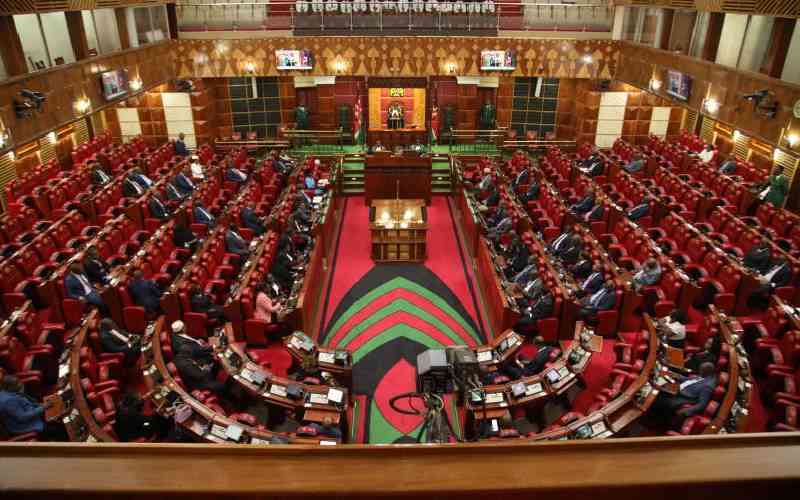
The forum brought together MPs and civil society actors to deliberate on the proposed law, which seeks to regulate religious organisations through mandatory registration, oversight, and compliance mechanisms.
Under the Bill, all religious organisations would be required to register with a state-appointed Registrar, with failure to do so attracting penalties of up to Sh5 million or imprisonment not exceeding three years.
It also requires organisations to be endorsed by umbrella religious bodies and supported by at least 25 members of the same faith.
However, participants at the forum cautioned that such provisions could exclude smaller or informal faith groups.
“The majority of the communities and societies within the republic are not aware; they are not well affiliated with it,” said Walid Kassim, executive director of MUHURI.
Kassim raised concerns that the Bill risks deepening exclusion, particularly for minority and indigenous belief systems, stating that the proposed membership of the commission excludes the African traditional beliefs.
He also took issue with the Bill’s requirement that religious organisations be endorsed by umbrella bodies before registration.
“So the proposed bill says that for you to be registered, you have to be recommended by a certain religious association. What if somebody does not have a religious association that they align with?” Kassim posed.
The bill states that for a religious entity to be considered eligible for registration, the application must be supported by at least 25 proposed or registered religious organisations professing a common faith and endorsed by at least five natural persons who have not been convicted of a criminal offence.
Bishop Francis Omondi of the Anglican Church of Kenya (ACK), Garissa said questioned the necessity of the proposed new law altogether, pointing to existing legislation such as the Societies Act.
“My thought was that the bill was not necessary because we already have laws that deal with regulating religious organisations. The laws are present, but they are not followed, so we cannot create new laws and expect that to still happen,” said Omondi.
He added that recent abuses, such as the Shakahola tragedy, were not due to a lack of regulation but to the failure to enforce existing laws.
“The bill is having similar contributions and similar laws to other acts, such as the Prevention of Terrorism Act, the Children Protection Act. Let us harmonise the bill and engage the people,” said Kassim.
Stay informed. Subscribe to our newsletter
Further criticism was directed at provisions requiring religious leaders to hold formal theological qualifications.
The Bill proposes that at least one religious leader must have a degree, diploma, or certificate in theology, but Kassim argued that this creates structural barriers for belief systems that do not operate within formal academic frameworks.
“What I mean is that somebody practicing Rastafarian religion, or the Kaya religion, cannot be able to certify themselves academically for them to qualify for membership and practice this religion,” he said.
“As a country, we do not have the necessary infrastructure for every faith to be able to be taken through academic qualifications,” he argued.
The Religious Organisations Bill, 2024, aims to regulate religious institutions and was drafted by a task force formed after the Shakahola tragedy, where over 400 bodies linked to a religious cult were found.
The Bill proposes a Sh5 million fine or up to ten years' imprisonment for religious leaders who use false miracles, blessings, or healings to extort money or property from people.
The bill also penalises religious leaders who use force or threats to coerce individuals into joining their religion, with fines up to Sh1 million or three years in prison.
Additionally, it prohibits churches from engaging in politics for power, with penalties of up to Sh500,000 or six months in jail.
The proposed law also states that parents will retain the right to decide their children's religious upbringing.
“Kenya has for a long time had little regulation around religious organisations, resulting in the emergence of extremist and predatory religious organisations,” reads the Bill.
The Bill also proposes the establishment of the Office of Registrar of Religious Organisation, granting sweeping oversight powers for the Registrar, including the ability to inspect religious premises, demand financial records, and suspend or cancel registration.
However, critics warned that such powers could be abused.
If it passes into law, each entity will be required to have a management structure consisting of a board of trustees, at least two-thirds of whom are Kenyan citizens.
“It’s also given privilege to certain officers in government to decide which groups to approve and which groups not to approve. So it can be abused and cause more chaos as we go forward,” Kassim added.
The Bill further mandates extensive reporting obligations, including disclosure of members, leaders’ qualifications, funding sources, and bank statements.
Critics argued that these provisions duplicate existing regulatory frameworks.
“If it’s money laundering, there is already a law on that. If it’s on the protection of children, there are already robust laws on that,” said Omondi.
Other extensive governance requirements include annual general meetings and detailed financial reporting, which were also criticised as imposing rigid structures on diverse religious practices.
“My other fear is that the law may cause more problems because reorganising religions in a model that it is suggesting will force religions to take on a shape that isn’t theirs,” said Bishop Omondi.
Ahmed Bashir from Kesho Alliance warned that privileging certain forms of religion could fuel marginalisation and even extremism.
“There is a group of people that might be excluded because of the African culture and the people who don’t have scriptures, but they do believe in some cultures,” said Bashir.
“We cannot regulate cultures, but once you give priority to people and you give them a registry, you are excluding a certain group.”
Harrison Mumia, president of the Atheists in Kenya Society, echoed these concerns, urging policymakers to strengthen existing systems instead of introducing new legislation.
“The debate really should not be about another law, but it should be about what we can do to the existing laws to make regulations,” he said.
Stakeholders also called for broader public participation, arguing that the Bill has been advanced without sufficient consultation.
While acknowledging the need to address abuses within religious spaces, including extremism and exploitation, participants insisted that any intervention must not undermine the constitutional right to freedom of religion under Article 32.
The team stated that the regulatory regime is fragmented across various statutes, therefore presenting a challenge due to the lack of an approval and enforcement agency to ensure that religious organisations operate within the law.
“The current framework neither promotes transparency and accountability in the management of funds, nor provides for self-regulation.”
“While the freedom of religion and belief is guaranteed under the Constitution, the outward manifestation of the belief is subject to legitimate guidelines that seek to promote a just and safe society that respects the right to life, human dignity, security of the person, freedom from servitude, privacy, and freedom of association and expression. “

Subscribe to our newsletter and stay updated on the latest developments and special offers!








 join
join