![]() |
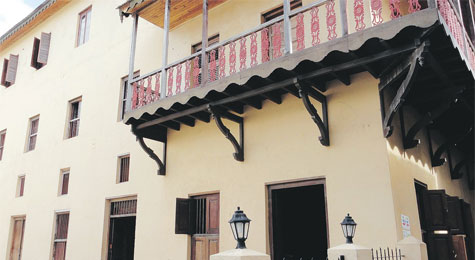
| The expansive house. |
Beside Mombasa’s Old Port stands the house that Ludwig Krapf built prior to venturing inland in his mission to evangelise the masses. Yet, the history of the house neither starts nor ends with Krapf, writes JECKONIA OTIENO
The history of the Leven House dates back to 1824. It is a fact that many of its occupants were important people and institutions.

The house stands out due to the distinct architectural work different from the traditional housing structures that make up the Mombasa’s old town. Despite this difference, some features stand out similar to the locale: the Swahili-style balcony, staircase and wooden doors still hold on to the touch of the old part of town.
Leven House was named after HMS Leven, a British naval survey ship, which docked at the coast in 1824. The house was at one point owned by the powerful Mazrui family which ruled the east coast of Kenya during a time when slave trade was a thriving business.
Sometime between 1824-26, British naval officers received orders from Captain Owen that they were to carry out administration in Mombasa as a protectorate. The officers therefore rented the house as an anti-slave trade base.
Slaves’ zones
Just near it, was a slave loading area that was used by the Arabs to load slaves into ships that were bound for other parts of the world mainly, the Middle East.
In 1825, one of the British naval officers, Lt Emery, constructed a tunnel to the jetty by the sea where he had a small boat for patrol. The same year, a well was also dug – not even five metres from the sea yet its water is not salty like sea water despite the near zero distance.
Sultan Seyyid Said of Zanzibar took over the ownership of the house from the Mazrui family and seven years later he allowed Krapf to occupy the house. It is in this very house that Ludwig’s wife and daughter died in 1844.
Two years later, different missionaries and explorers stayed in the house; most notable among them were Johann Rebmann who would later join Krapf in Rabai. John Speke and Richard Burton were among the first explorers to take residence at Leven House.
Ownership tussles
Wrangles over the ownership of the house were not yet over as in 1884, Salim Bin Hamisi el Mazrui, who was the Liwali of Takaungu, successfully lay claim to the house bringing it under the Mazrui family again. He then sold the house to the Church Missionary Society (CMS) where the CMS medics practised medicine.
Latest Stories
- Relief as surgeons re-attach man’s severed private organ
- Can medical board really bite finger that feeds it?
- Mother claims nurse watched her newborn die
- Governor’s encounter with leaky roofs in school
- Police arrest former councillor for piracy
- Cord leaders allege ploy by State to ‘kill’ devolution through Ministry