![]() |
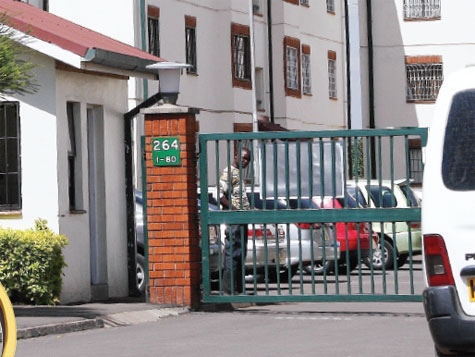
| Entrance to Nyayo Estate in Embakasi, Nairobi. [PHOTO: MARTIN MUKANGU/STANDARD] |
By Muchiri Waititu
One early morning way before sunrise in September 2008, the Embakasi Police Station Commander was hastily alerted by the station officer in charge. Apparently, there was a congregation of unidentified people at the National Social Security Fund’s Nyayo Estate and the crowd kept growing.

By 4.00am, there were already over a hundred people and the crowd was still swelling in direct proportion to the security apparatus concerns. By 4.30am, the concerns had reached the top echelons due to the proximity of the national airport and the army barracks.
The puzzle was only dissipated when it was realised that the good citizens were only pursuing the right to own a house in the Nyayo Estate after the NSSF had advertised the sale of Phase Two. The houses were being allocated on a first come first served basis and the early birds were rewarded appropriately because the units had been sold out by midday.
Urban myth or not, the anecdote forms the basis of today’s topic; is the housing bubble about to burst?
As a consultant, an occupational hazard you get used to is the dissipation of free advise to strangers in social joints. A typical ice breaker starts with the pro-bono client setting the tone with his declaration that he purchased a plot in Katani an year ago and has recently been offered a price that is twice the original. “Isn’t this a clear case of a bubble about to burst?”, he will ask.
Property bubble
A property bubble, like any other investment bubble is caused by a dramatic increase in housing prices fuelled by demand, speculation and the?belief that recent history is an infallible forecast of the future.?
Housing bubbles usually start with an increase in demand usually due to sudden availability of cheap credit or improved infrastructure, in the face of limited supply which takes a relatively long period of time to replenish and increase.?
Speculators then enter the market, believing that profits can be made through short-term buying and selling thus further driving demand.?This is the scenario that is currently playing out very markedly in areas around Thika Road, Mombasa Road and Namanga Road areas.
At some point, demand decreases or stagnates at the same time supply increases, resulting in a sharp drop in prices — and?the bubble bursts.
So is the bubble going to burst? According to the definition above, the ingredients required for this are exponential supply and reduced demand. Looking at all major statistical indices, housing supply has actually been falling for the past year or so.