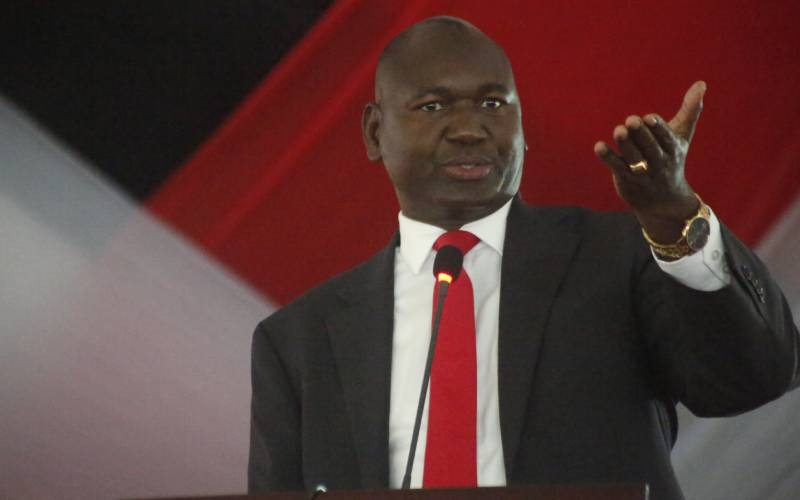
“The government interviewing panel was quite surprised by my application, as they were used to dealing with those who could not find a place in the private sector. After appointment, I immediately started handling significant criminal and civil cases, while my contemporaries who had gone straight into private practice spent years in the lower courts before any client would entrust them with a major case,” says Philip.
Philip would later serve at the Provincial State Counsel’s Office in Nyanza and later in Nairobi for the next seven years, leading or assisting in prosecuting a number of high profile cases that included murder and treason.
“I was handling cases that should have been handled by officers beyond my job group. This included holding briefs for the then Director of Public Prosecutions (DPP) Bernard Chunga. I had to prepare well and articulately present my arguments before the courts,” he says.
In 1992, however, Philip found it impossible to survive on the meagre salary of Sh5,000 with a young family.
“My wife Agnes was also a state counsel. Our salary could not sustain us. We had the choice of either going into the matatu or kiosk business, or leave with clean consciences. We opted for the latter,” says Philip who, together with Agnes, quit the civil service in 1992 to start their law firm, Murgor and Murgor Advocates.
Surprisingly, his first major brief was to represent the then President Daniel Moi in an election petition filed by his opponents in the first multi-party elections in Kenya.
Among other famous briefs was representating Central Bank of Kenya in its bid to recover billions of shillings lost in the Goldenberg scandal.
However, the job that was most problematic was the unexpected and unsolicited appointment as the DPP in 2003 by President Kibaki. Philip maintains that he never applied for the job. His selection, he says, was informed by his exemplary and steadfast performance in the Goldenberg cases, including the refusal to be cowed by threats from powerful individuals.
Anglo Leasing
“The DPP’s position is the most difficult assignment in Kenya. One ceases to have friends. Can you imagine defending graft suspects in court, socialising with them and then having to prosecute them later as the DPP? They ones will expect favours from you. If you cannot change your lifestyle, turn down the appointment,” he says.
Philip says he had observed the lonely life led by Chunga and would never have wished it on anyone. Philip reluctantly accepted the appointment after he was assured that he would have a free hand to reform public prosecutions and negotiate his terms and conditions.
But the honeymoon was short-lived. A year down the line, some powerful individuals in government detested his zeal. The ghosts of Goldenberg, Anglo-leasing and the Sh6.4 billion cocaine cases cast deep shadows within the inner circle of the administration. Philip seemed to exhibit no sensitivity for the politics of the day with some describing him as being “out of control”.